Tuesday, 26 January 2016

Regeneration


The warm December has encouraged the stumps of the hedgerow that was cut down along the bus link to regrow.  This is hawthorn but the leaves of blackthorn and field maple are also visible.  Spring is in the air!


In the stream the weed is already beginning to grow too.  A lot of other things have changed since I last looked too!  The borrow pit below has filled with water and wildlife is making itself at home.  A mute swan appears to have found something to feed on, and flocks of black headed and black backed gulls seem quite at home next to the M1.


 Further west towards the town centre, work has been done to trim the hedges bordering the stream, but sadly vandals have taken the opportunity to use it as a dumping ground again. 


We can do something about this eyesore by banding together and working with CBC and Groundwork to care for the stream and keep it clear of rubbish like this.  As Houghton Brook starts in the town centre adjacent to Houghton Hall Park, and is already part of their regeneration programme, it is likely the Friends of Houghton Brook will join with the Friends of Houghton Hall Park to clean up and protect the stream all the way from its source at the pavilion, through Parkside and HRN1 to where it goes under the M1 to Luton.  So wherever you live in Houghton Regis, you can help in the area nearest to you.
 
Will you become a friend of the stream too?  The health of the stream is important both for our welfare, safety from flooding, and the welfare of the wildlife living there and further downstream.  But it needs active helpers to keep an eye open for anything amiss and report it. 
 

Thanks to those who have responded so far.  Please contact me via the contact button on the right to show you care for Houghton Brook and would like to help.

Regeneration is already taking place -

why not become part of it and help improve

our town's natural environment?


Monday, 23 November 2015

Friends of Houghton Brook

Over 1000 people have read my blog since I started it, and many more have read it on facebook.  Thank you so much for your interest and support.

It is now time to ask my readers whether you would like to get involved in looking after Houghton Brook by becoming a member of a potential Friends of Houghton Brook group.  Activities might involve learning about the flora and fauna, picking up litter, monitoring the health of the stream and just enjoying it and sharing that enjoyment with others.  All ages can get involved and families are welcome.

You can let me know via the contact link to the right.


I look forward to hearing from you!

Monday, 26 October 2015

Houghton Brook from the M1 to the River Lea

Yesterday I cycled along the footpath beside Houghton Brook from the M1 to where it joins the River Lea in Leagrave Park, a very pleasant sunny outing.  I even met two readers of this blog on the way!


Having cycled under the motorway, Houghton Brook appears on the left and is at first contained by concrete.


The new housing has been built on what was a large grassy field.


A thick hedgerow rich with autumn fruits overhangs the stream.


Grassy banks shelter small mammals like voles and provide food for insects and butterflies.


From this point onwards tall trees shade the stream till it reaches Toddington Road.

 
Vincent Road


Looking back round the bend as it turns to run alongside Toddington Road.


Emerging from the trees it then runs alongside Knapps Farm Leisure Gardens.


These 'trash pins' in the foreground collect rubbish before the stream flows through pipes (below) under Toddington Road, the railway line and Sundon Park Road.


This is where Houghton Brook emerges in Leagrave Park.


Here it begins to look more like a river and after a short distance it flows into the River Lea at a T-junction not far from its source at Wauluds Bank.


This picture taken in March shows the confluence more clearly, the swan marking the spot!


Thursday, 8 October 2015

Losses and Gains


Remember this photo?  This is the hedge along the west side of the old buslink which was marked on the revised plans as being retained.  Now you see it...


...now you don't.  This tragic mistake was probably due to the master plans not being updated with the revised plan.  In spite of the fact that I mentioned my appreciation for the retention of the hedge many times in my conversations, it apparently didn't register.  They have promised to replant the hedge but it will take a long time to return to the 12ft or so it was.  The night before this disaster I had watched Alan Titchmarsh on TV planning and planting a garden at Keech Hospice outside Luton, and I was interested to see that one can buy blocks of half-grown native hedge with all the right species in, which we had here.  If it takes, it will soon start to grow, so this gave me hope that perhaps all is not lost.  I hope they will replant it as soon as possible and give it the best start to the quickest growth.  However, it will be a long time before birds can nest again in it.  At least dog walkers have no excuse now for not using the doggie bin!

In August the fruiting trees gave a wonderful show, perhaps the best ever that I remember.

 
Wayfaring Tree
 
 
Apples - sadly gone to waste this year as they are beyond reach
 

Sloes
 

Rowan berries and Travellers Joy (Old Man's Beard)
 
What else is going on?  This slightly tatty speckled wood butterfly found it nice and warm on the fence by the footpath to Wheatfield Road.


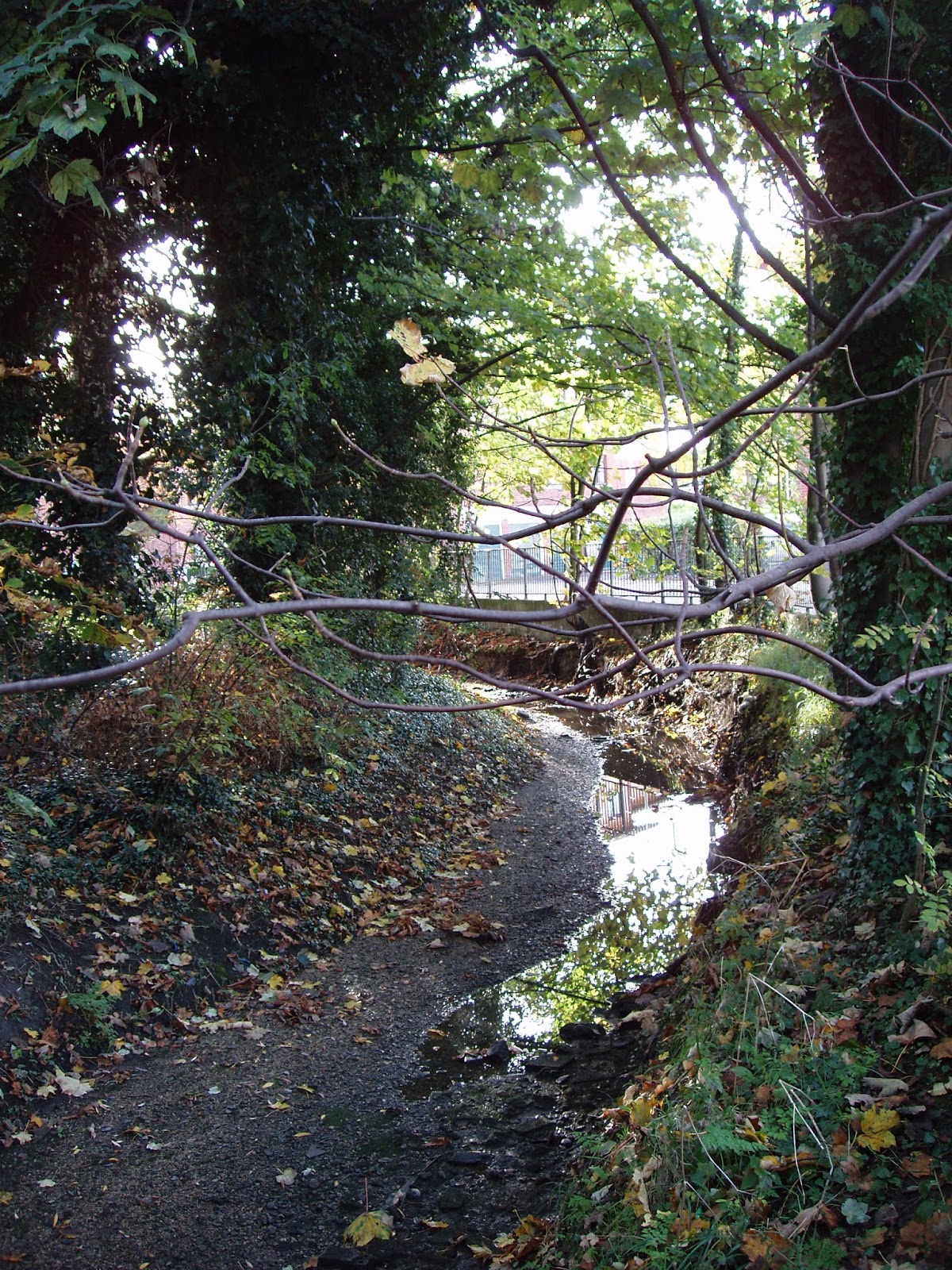
A wander up the stream gave some delightful reflections in the dappled shade.


 The starlings are very vocal and never cease to amuse as they gather on the pylons and wires that soon will come down.  I hope they won't desert us altogether, I find their antics very entertaining.  But their roosts must be overcrowded by now.

 
The poisonous berries of Lords and Ladies


A close up of the heart-shaped leaves of the black poplar.  This is the grove of younger trees which ARE MARKED ON THE MASTER PLANS AS BEING RETAINED, as is the mature tree currently being protected from all the works around it!  I shall be keeping a close eye on these trees.  They are the favourite for a particular type of moth which I haven't yet discovered, which the local gulls love.


Toadflax, an important food plant for a large number of insects and moths
 
 
NEWS UPDATE ON HOUGHTON BROOK
 
As I reported in my July post, I had profitable discussions with the contractors about protecting and caring for the stream into the future.  Representatives of both Balfour Beatty and Amey for CBC said: "We can help with this."  I wrote a summary of our discussions to Howard Dobson but have not heard anything since.
 
On 7th September I spoke at the Town Council Environment and Leisure Committee to update them on these discussions, my site visit with a contractor to find the bee orchids, the sewage spill into the stream and my request that the Wildlife Trust be permitted access to the stream in March/April 2016 to do a survey of the water voles.   
 
On September 17th Luton Today published a report on the work done by the Luton Lea Catchment Partnership to open up the source of the River Lea and to increase public awareness of this historical site, which prompted me to contact Maddy Kershaw of Groundwork through the website  http://www.riverleacatchment.org.uk/ .  Maddy manages the projects in the Luton area of which there are many.  Do have a look at the website as it shows what may be possible for Houghton Brook. She was most interested in my blog and my ideas and keen to get me involved by inviting me to join any relevant meetings.  They also have contacts with CBC and the Wildlife Trust.
I then passed on the above information to CBC via Howard Dobson and await a response from CBC and the contractors.
 
On 23rd September I attended the Wildlife Trust talk on Chiltern Chalk Streams and learnt a lot about river flies and how we could discover for ourselves the health of the stream by monitoring these flies which are the basis of the food chain on which fish and birds feed.  This is very exciting because this is a 'citizen science' which anybody can learn to do.  I re-read surveys of the stream done by CBC before the plans for the Woodside Link were approved.  These surveys measured the numbers and variety of these flies.  This is a means of discovering the state of the water and how it should be improved. 
 
This talk took my mind back to the very first TV programme I watched as a child, called 'Look and Learn' I believe, about Life in the River and showing very murky underwater pictures of river flies and larvae and freshwater shrimps.  Considering the popularity of Spineless Simon the Stickleback in Springwatch this year, I think the message of the importance of all these creatures in the food chain may be getting across!  I shall never forget seeing a freshwater shrimp this spring in Houghton Brook.  It is still a live stream!
 
YOU!
 
Thank you for all your encouragements to keep doing what I'm doing.  I have appreciated them especially recently.  I have also met some nature enthusiasts on my walks who are equally keen to continue enjoying the wildlife, flowers and trees of this area after all the works are finished.  There may be something we can do together to this end so please do contact me if you are willing to get involved.  And do have a look at what the River Lea Catchment Partnership in Luton is doing as they are an excellent example of what local volunteers can do in their own landscape.  http://www.riverleacatchment.org.uk/


Friday, 31 July 2015

Scrubland


Re-reading an old copy of Birds magazine (RSPB) from 2008 I came across an article about 'Scrub' and the tendency to consider it unkempt, untidy and fit only for building homes on or prettying up to create parkland. What is 'scrub'?

"Scrub is rough and unplanned; scrub is unexpected... a tangle of bushes and thorns, nettle beds full of butterflies ...long grass growing through brambles and hawthorns... the first coltsfoot flowers before it is spring... the first willow warbler fresh in from Africa... the lesser whitethroat bursting into its rattling song from the blackthorn thicket... blackberries and elder bushes rich with fruit... hawthorn berries that attract flocks of fieldfares and redwings in winter..."

Scrub is a place of discovery and observation, full of the buzz of bees and the chirping of crickets, and overhead the calls of kite and buzzard. There are only a few patches of hawthorn scrub left on the Shanley land as it has mostly been torn out, leaving grasses and wild flowers to take over which they have done in abundance and rich diversity.  The grassland is a perfect habitat for insects, beetles, butterflies and bees but less so for nesting birds, large mammals like foxes and reptiles. 
Long live scrub!

Golden Rod, probably a garden escape
Common Fleabane


St John's Wort

 
Evening Primrose


Scentless Mayweed


Cricket
 
 
Large Skipper on Teasel
 
 
Bee on Field Scabious
 
 
Woolly Thistle and bee
 
 
Ladybirds on seed heads
 
 
Gatekeeper butterfly
 
 
Rose gall - nest of a gall wasp on wild rose
 
 
Everlasting Pea
 
 
Wild Thyme
 
 
Field Bindweed


The first blackberry is ripe and ready for eating
 
 
Wild apples ripening in the sun
 
 
View south from the top field towards Blows Down
 
Now go and see how many you can find.
Long Live Scrub!